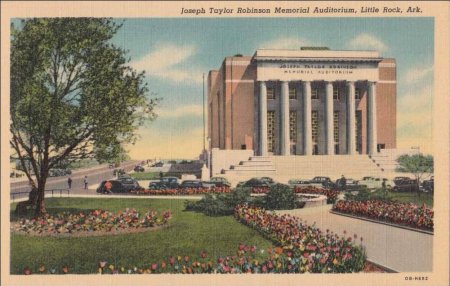
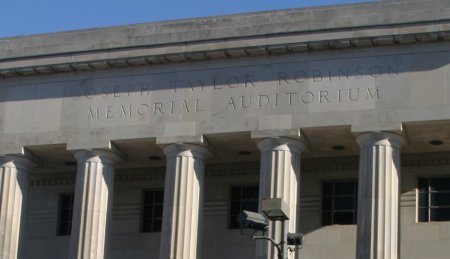
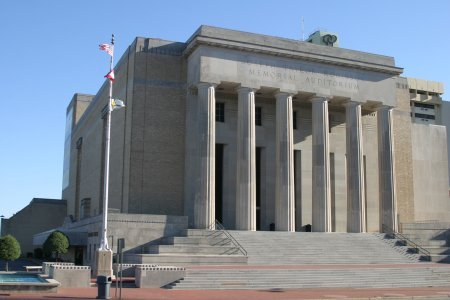
Joseph Taylor Robinson Memorial Auditorium in Little
Rock, AR
courtesy www.delcampe.net
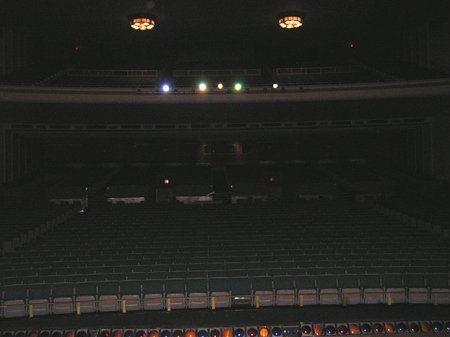
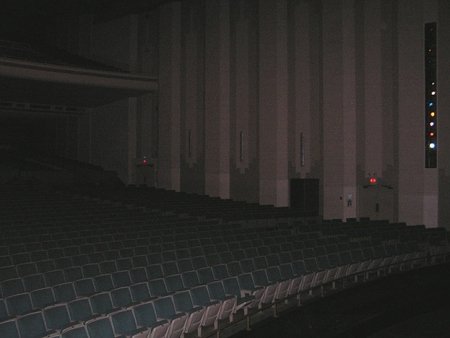
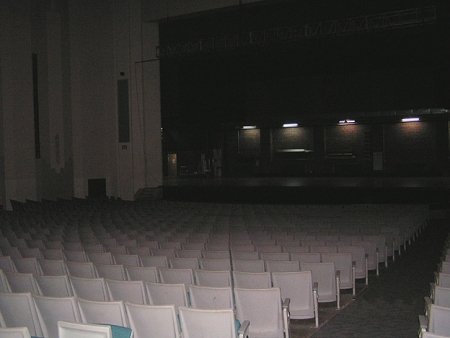
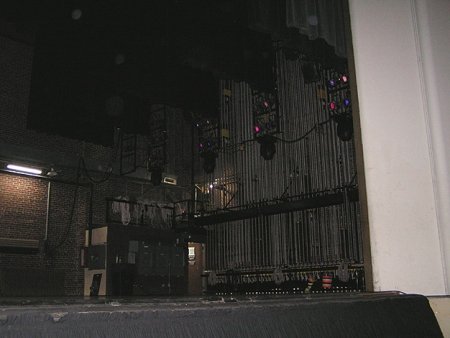
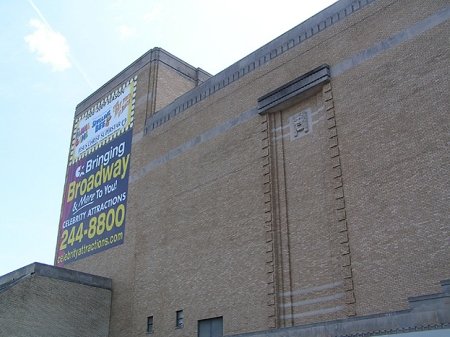
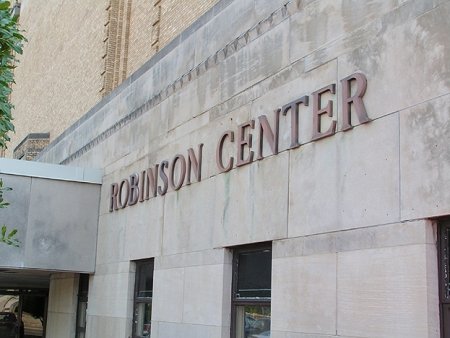
Built in downtown Little Rock (Pulaski County) during the Great Depression as a Public Works Administration (PWA) project, the Joseph Taylor Robinson Memorial Auditorium—known since 1973 as the Robinson Center Music Hall—frequently hosts touring performances, including Broadway musicals, and is home to the Arkansas Symphony Orchestra. Named for Lonoke County native Joseph Taylor Robinson, who was governor of Arkansas and a U.S. senator, the Art Deco building on Markham Avenue near Broadway Street is a major Little Rock landmark.1
Prior to the construction of the Robinson Center, Little Rock’s largest auditorium for concerts and other public events was at Little Rock High School (now called Central High School). Senator Robinson, a strong supporter of President Franklin Roosevelt’s New Deal, helped to bring several major projects to Arkansas, including a new civic auditorium. Unlike other New Deal programs, the PWA required local funding to accompany federal dollars. On January 26, 1937, Little Rock voters approved a bond referendum to help fund the auditorium, as well as additions to the public library and a city park for African Americans.1
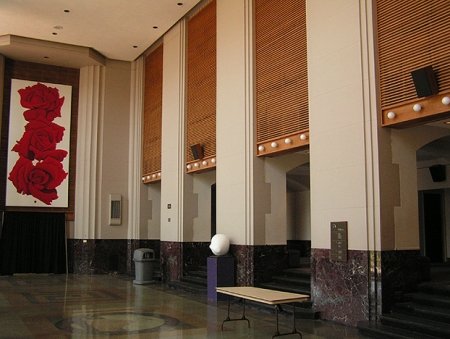
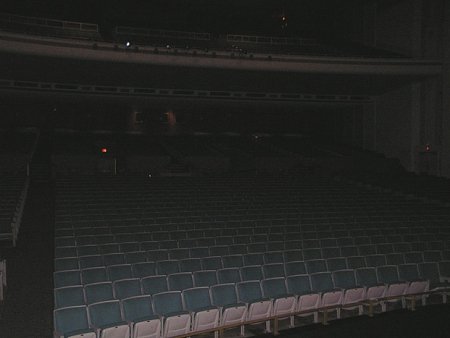
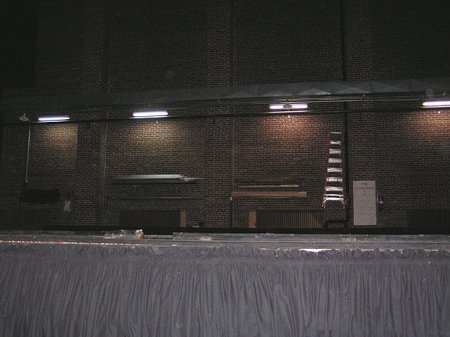
Construction of the auditorium began on December 27 of that year and was largely completed by December 8, 1939. The structure was received by the City of Little Rock on January 24, 1940, and formally dedicated on February 16, 1940. The building was named for Senator Robinson, who had supported its creation; he died in 1937. The total cost of construction was $855,000, more than $200,000 over the initial budget. In addition to the main stage and arena, including mezzanine and balcony seating, the building also holds lecture/exhibit halls and meeting rooms. As originally designed and built, the auditorium had two separate performance venues on an upper and lower level. Its team of architects included the firm of George Wittenberg and Lawson Delony, as well as associate architect Eugene Stern, all of whom had designed many other prominent buildings in Little Rock and around Arkansas.1
The first use of the auditorium was as a basketball court for high school games, but orchestral performances, ballet, and traveling theater rapidly came to the impressive new building. During the 1940s, the building also was used as a community center, offering ping pong, shuffleboard, bridge, checkers, and domino tournaments. Among the many famous performers and speakers to appear at the Robinson Memorial Auditorium in the 1940s were Louis Armstrong, Katharine Hepburn, Ella Fitzgerald, Mae West, Gene Autry, Bob Hope, Ethel Barrymore, Duke Ellington, Guy Lombardo, Eleanor Roosevelt, and Dwight D. Eisenhower. Some performers would offer two shows on the same day to different audiences, one upstairs and one downstairs.
Elvis Presley performed at the Robinson Center in 1955 and 1956; for the
first appearance, he was paid $150, but he grossed $9,000 when he
returned a year later.1
Arkansas Democrat Feb. 13, 1955
Arkansas Democrat Feb. 18, 1955
Arkansas Democrat Feb. 20, 1955
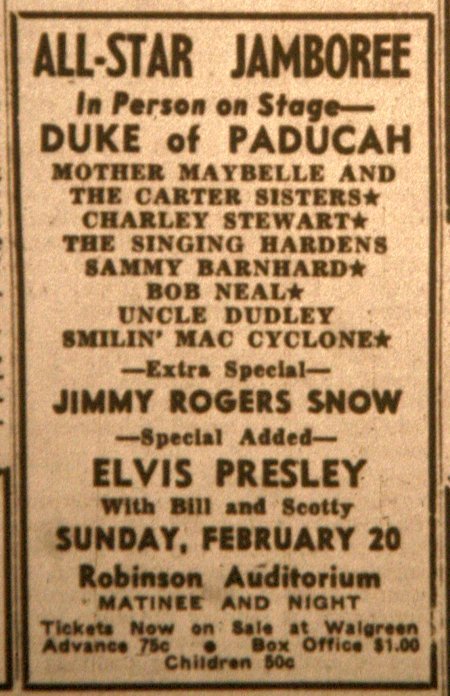
On February 20, 1955, Elvis, Scotty and Bill began a weeklong tour
of Arkansas and Louisiana with their first appearance at the Robinson
Auditorium. As advertised there were two shows that day, a 3 p.m. and an
8:15. Tickets sold at the box office for $1.00 for adults and .50 for
children, while advanced tickets sold for .75 at Walgreens. Billed as
both the “WSM Grand Ole Opry" show, and "All-Star Jamboree, it featured
the Duke of Paducah, Mother Maybelle and the Carter Sisters,
Jimmie Rodgers Snow, Charlie Stewart, the Singing Hardens, Sammy
Barnhart, Bob Neal, Uncle Dudley and Smilin' Mac Cyclone.
According to Lee Cotten, Charlie Stewart was another RCA Victor
recording artist managed by Colonel Parker at the time and Uncle
Dudley was the stage name for Ernest Hackworth of
KTWNradio in
Texarkana. Hackworth promoted this tour in conjunction with an old
friend, Colonel Parker. Bonnie, Ernest’s first wife, and Marie Parker,
the Colonel's wife, sold tickets, "Hack” acted as the program’s emcee,
and the Colonel worked the crowd selling programs. The Colonel later
offered Hackworth a part of Elvis’ contract for $3,000. Hackworth, who
didn’t much care for rock ‘n roll, turned it down, preferring to remain
in radio. It is believed that Gladys and Vernon Presley attended this
performance, invited by Elvis who wanted to introduce them to the
Colonel. Gladys was a big fan of the Duke of Paducah.2
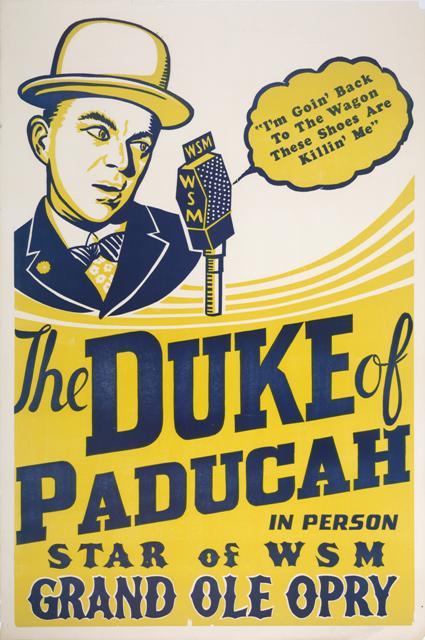
Comedian and banjo player Benjamin Francis “Whitey” Ford was born in DeSoto, Missouri in 1901 and appeared on the Grand Ole Opry from 1942 to 1959. Ford originally developed the Duke character on the air of
KWK-AM, St. Louis in the early 1930s and carried the character over to his own show with Red Foley in 1937,
on the Renfro Valley Barn Dance. Ford’s signature tagline was “I’m going back to the wagon, these shoes are killing me.”
They boys had only earlier that month begun their official association
with Colonel Parker, Hank Snow and their Jamboree Attractions. After a
meeting between shows at Ellis Auditorium in
Memphis initiated by Bob Neal, their help had been enlisted for
bookings. The first booking they got from them was in
Roswell. The Colonel though had known
of Elvis sometime before that and already had his sights on getting
control. According to Bill
E. Burk, Hackworth had seen Elvis earlier at the Hayride and is
reputedly the one who called the Colonel and said, "There’s a
kid at the Hayride tearing ‘em up. You’ve got to come down here and have
a look." Oscar Davis though, is
probably the first to have clued him in after meeting him at the
Eagles Nest in Memphis the previous
October.3
On August 3, 1955 they returned for their second appearance in Little
Rock at the Robinson Auditorium. Billboard listed it as part of Bob
Neal's "eighth anniversary tour" that started by drawing capacity crowds
in Tupelo at the fairgrounds on the 1st. This tour featured Webb Pierce,
Elvis, Scotty and Bill, Red Sovine, Wanda Jackson, Bud
Deckelman and Charlie Feathers. Local attraction Sammy Barnhart
was again added to the line-up in Little Rock and they played the night after in
Camden, Arkansas,
and concluded in Memphis
on the 5th at the Overton
Park Shell. Sonny James and Jim Wilson joined them in Memphis
and Johnny Cash performed several dates on the tour as well.
Arkansas Democrat - Aug. 2, 1955
Charlie Feathers at Sun - ca.1956
Photo courtesy J.Huffman/Escott and Good Rockin' Tonight
According to Lee Cotten, the Little Rock show drew an estimated 3,000
and Gladys and Vernon Presley were remembered to have been on hand
for this show. They drove to Little Rock specifically to meet again with
Colonel Parker at Elvis’ insistence. As an extra incentive, the Colonel
brought along Whitey Ford, the Duke of Paducah, who happened to be the
Colonel’s neighbor in Madison, Tennessee. As mentioned earlier, the Duke
was a favorite of Gladys. After all this attention the Presleys still
did not sign a contract with Colonel Parker that would have allowed him
to become Elvis’ "special adviser." They would however sign less
than two weeks later, on the 15th, granting him exclusive territorial
rights to book him in 47 cities and the exclusive right to negotiate any
renewal to existing contracts on his behalf.2
Only several weeks before Elvis, Scotty and Bill had recorded what would
be their last single for Sun, Mystery
Train, the flip side of which was I Forget to Remember to Forget,
written by Stan Kessler. According to Kessler, he needed a good
demo of the song and got Feathers to sing it for which he gave him 50%
of the royalties. According to Feathers though, Stan started the
song and he finished it, also making the somewhat dubious claim that he
worked out the vocal licks and taught Elvis the vocal arrangement.3
Feathers, originally from Holly Springs, MS, had been
around Sun and Sam Phillips at least as early as October of 1954 and in
1955 started spending time at Sun on a regular basis. Colin Escott
describes him as a superb stylist who made a handful of brilliant
records though eclipsed by larger than life boasting.
Frustrated at Sun, he went to Meteor records in May of 1956 and his trio
would later tour on package shows with Warren Smith, Johnny Cash, Jerry
Lee Lewis, Johnny Horton and Roy Orbison. They would even make one
appearance in Dallas on the Big D Jamboree
but would never rise to more than an underground figure in Memphis.3
Arkansas Democrat -
May 14, 1956
Arkansas Democrat -
May 15, 1956
Arkansas Democrat -
May 16, 1956
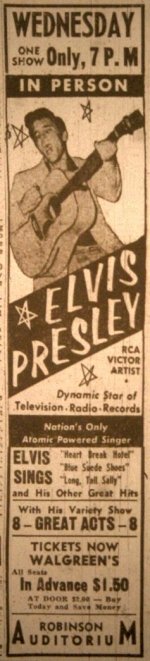
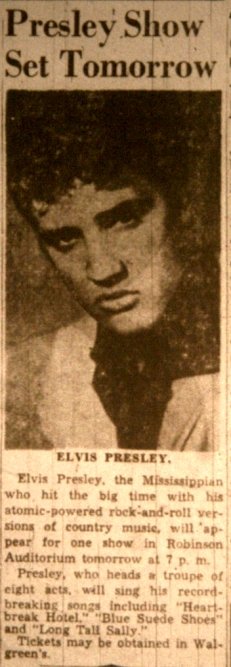
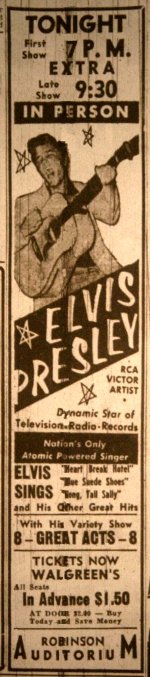
By their third and last appearance at the Robinson auditorium on May 16, 1956, the price of the show had
doubled to $1.50 in advance at Walgreens and $2.00 at the box office.
The ads featured 8 great acts in "his" variety show which consisted of
the Jordonaires; Rick and Emil Flaim and their orchestra; vocalists
Frankie Conners and Jackie Little and comedian-magician Phil Maraquin.
The review in the Arkansas Gazette the following day read:
Auditorium Pandemonium Elvis Cools Cats Down To a Dungaree Delirium By Jack Blalock and Ray Moseley of the Gazette Staff
It started as a chant of "We want Elvis," mounted to a wave of hysterical screaming and from then on the cats had a ball.
Elvis Presley, his guitar and his singing caused it all last night - the biggest mob scene the Auditorium has ever witnessed.
Teen-aged rock-and-roll fans started lining up 5 1/2 hours before his appearance and at show time the auditorium was packed, with hundreds more waiting outside.
Presley, flashily dressed and beaming broadly, took it all with ease as he sang for two worshipful mobs.
The 21-year-old singing star was scheduled to appear at 8 p.m. but he missed a plane connection in Memphis and did not come on stage until almost 8:30. The delay merely heightened the pandemonium in the Auditorium.
Thirty minutes before his arrival, the big hall started rocking with waves of rhythmic applause and cries of "We Want Elvis!" The crescendo mounted to a hysterical pitch when the stage lights came on.
The curtain parted and a blue jacketed master of ceremonies bubbled: "Bless your
hearts, you're going to get him." That touched off another round of screaming.
Then the crowd booed and hissed intermittently as another act performed. Plainly they wanted Elvis.
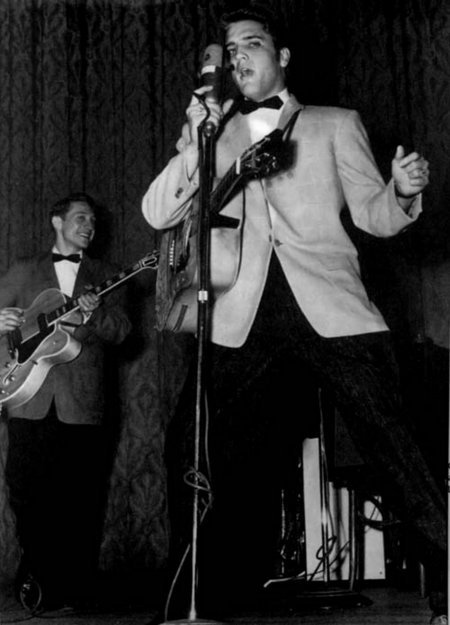
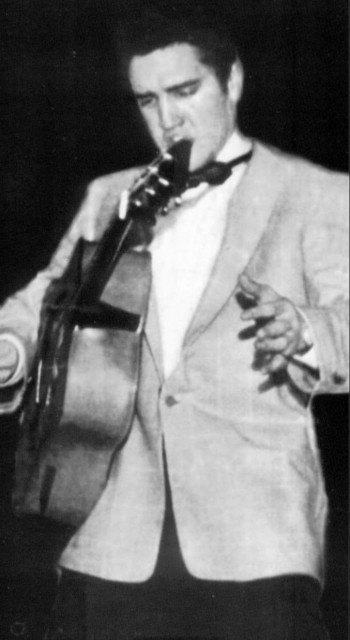
Scotty and Elvis onstage at Robinson Auditorium, Little
Rock, AR - May 16,
1956
In Person; In Purple
The master of ceremonies returned, fumbled through an introduction that no one cared to hear and then it happened.
Out of the curtains on the right emerged a broadly smiling Presley, garbed in a violet purple coat and black silk slacks. A guitar was draped over his shoulders as he slinked toward the microphone.
Instantly, the crowd was on its feet, screaming and waving. The front rows surged forward.
Presley continued to beam, wrestled the microphone toward him and suddenly burst into the opening notes of his most popular song "Heartbreak Hotel."
That was more than the teenagers could take sitting down. On the left side of the auditorium, they rose in a body and stormed down the aisle, then stood screaming on the brink of the stage.
Presley gyrated wildly on stage, drawing louder screams each time he flicked a leg in hula dancer fashion.
Police Herd Them Back
Policemen scrambled down the aisle after the teen-agers and finally persuaded them to return to their seats.
The screaming never subsided during the rendition.
The notes came through only now and then, but it didn't matter.
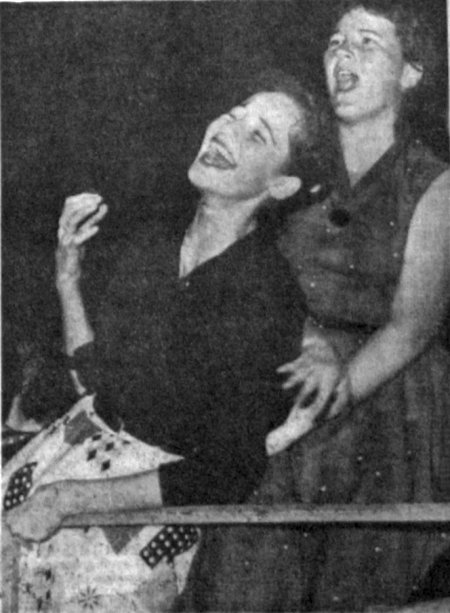
She's Screamy 'Cause He's Dreamy The kids just go wild when Elvis sings and wiggles.
Elvis was on stage.
The crowd quieted somewhat after the first number but each new song brought its own moment of hysteria.
outside, hundreds of teen-agers thronged the Auditorium steps, waiting for the second show.
It was strictly a night for the dungaree set and few oldtimers -- anyone old enough to vote -- ventured to the site of Presley's triumph.
The girls came to look pretty for Presley in smart spring frocks, but the boys wore dungarees.
The youngsters paid $2 at the door or $1.50 for advance sale tickets to hear Presley sing.
... Oscar Davis of Memphis, a press agent for Presley, said that the teen-agers' idol was deliberately late because of shrilling mobs that had pressed him too close in the past.
"Too much trouble in other towns," Davis said. He had been with Presley five months.
Davis glanced with a practiced eye at the house and said the crowd was "real great for Little Rock."
At other towns, he said, mobs "beggared description."
"We want Elvis." The chant began at 6:15 p.m. Thirty minutes later the chant grew to a concerted roar.
It's not just the song, it's the sight of Elvis
himself singing it.
Squealed at the Thought
From time to time infectuous squeals arose from female admirers a they thought Elvis was entering. Then they died to an impatient mumble.
At 6:40 p.m. Harville ordered an end to ticket sales for the 7 p.m. show.
A second show was
scheduled for 9:30 p.m.
Harville said early in the evening that it wasn't the largest crowd he had seen at the Auditorium, but it was the largest bunch of
teen-agers.
"A crowd like this is milling all the time," Harville said.
To control the crowd there were 10 off-duty Little Rock policemen. there were two firemen keeping a watchful eye.
Who's Elvis Presley
The police took the mob scene casually. The adult spectators scattered in the crowd appeared either determined or sheepish.
The fame of Presley is centered in the rock-and-roll crowd and admirers of his hill-billy style. But lots of Arkansans had hardly heard the husky crooners name.
"I wouldn't know him if I saw him. And I wouldn't be here unless I was being paid," commented a patrolman.
"They might tear the place down before he gets here," said another patrolman at 6:45 p.m. He explained wisely: "They go nuts you know."
Arkansas Gazette May 17, 1956 courtesy Little Rock Public
Library
Elvis onstage at Robinson Auditorium, Little Rock, AR - May 16, 1956
Photo courtesy Cristi Dragomir and TCB-World
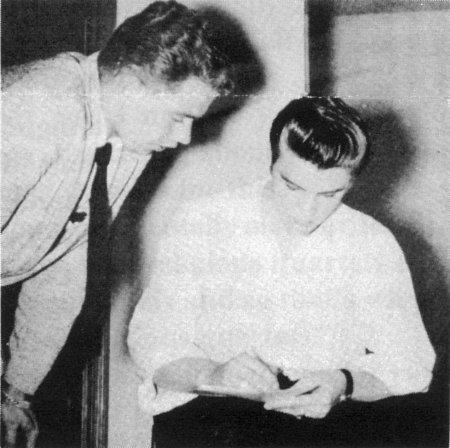
Elvis signing autograph for KLRA Deejay Ray Green - May 16, 1956
if audio doesn't play in your browser
click here
Photo courtesy Brian
Petersen
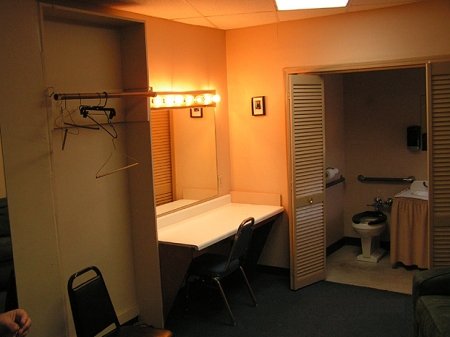
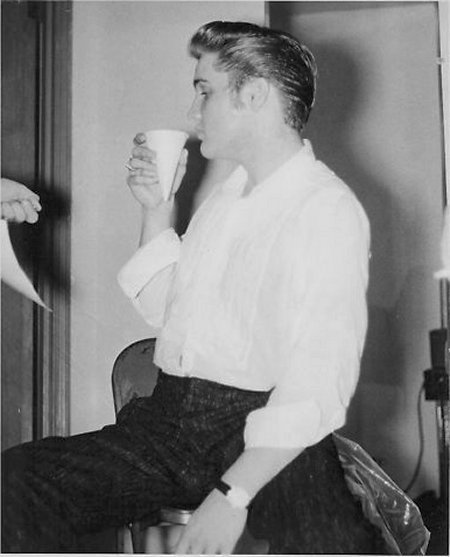
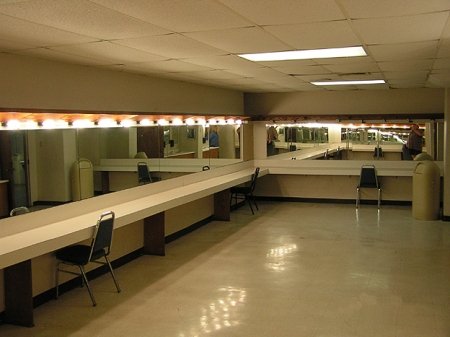
In between shows backstage Elvis was interviewed by KLRA
deejay Ray Green. Green started his career in radio in Little Rock
where he developed his own daily radio show called 'The Ray Green Show'.
He is said to have the highest rated radio audience in radio history for
Arkansas. During the latter part of the interview before Elvis
returns for the second show, Jackie Little backed by the Flaim brothers
can be heard singing onstage.
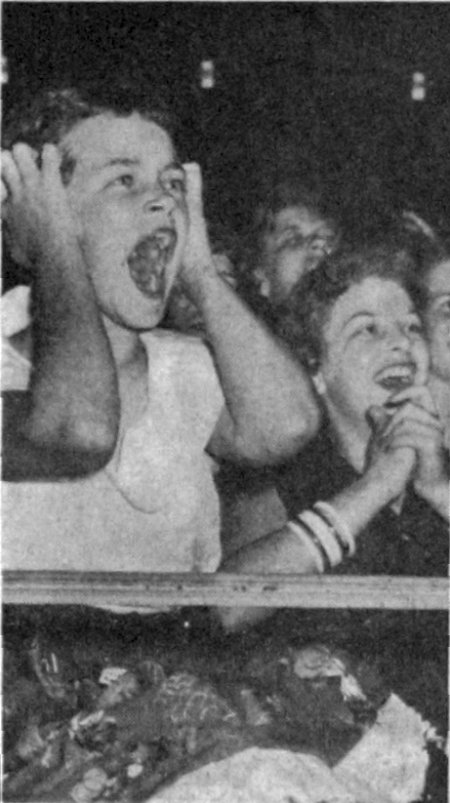
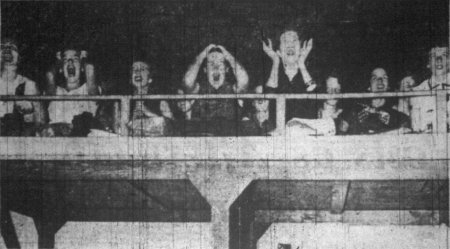
REALLY SENDS 'EM - Elvis Presley "sent" these
teen-agers "a-rockin and a-roll-in" while singing and shaking out
one of his self-styled "hi want you, hi need you" songs. This
front row scene was typical in the packed Robinson Auditorium last
night. The ticket demand was so great that Presley presented a
second show.
Arkansas Democrat Photo by Cranford courtesy Little Rock
Public Library
Ray Green held on to that interview in his private collection and also a
recording of one of Elvis' entire performances. Years later it was
rediscovered and released though RCA on collector editions.
During the 1940s and 1950s, seating in the Robinson Center was often segregated by race. Music manager and promoter Jim Porter Jr. sought to overturn this policy in the wake of the desegregation of Little Rock’s school system. In 1961, he was arrested during a Ray Charles concert at the center for sitting among black audience members; other concerts by black performers such as Duke Ellington were canceled because of the segregated seating. By the time Louis Armstrong performed at the Robinson Center in September 1966, this policy had ended.1
In 1966, the Arkansas Symphony Orchestra made the Robinson Memorial Auditorium its home. The building underwent extensive renovation in 1973, with underground parking added in the place of the lower performance hall. An attached hotel was erected to the east. At this time, the name was formally changed to the Robinson Center Music Hall. Famous acts continue to appear at the Robinson Center, including traveling Broadway shows such as Les Miserables, Riverdance, and Wicked. Since its renovation, the auditorium seats 2,609. The building was added to the National Register of Historic Places on February 21, 2007.1
According to the
Internet Movie Database, after radio, Ray Green began acting in commercials, and got some small parts in different
television series. Finally, he won the role of Lomax in his first and last feature film 'Axe', which also carried the name of 'Virgin Slaughter', 'California Axe massacre' & 'Lisa, Lisa.
After 'Axe', he developed a line of motivational kits, and tapes called 'Redirectional Thinking' and traveled as a motivational speaker and a sales trainer, encouraging and training people all over the country.
Ray Green now lives in Lafayette, Louisiana with his wife. He is involved part time in local public television, and still gives occasional interviews about his Elvis Presley interview. He has 4 children and 6 grandchildren.
Ray is also the founder and president of the "I
Met Elvis Fan Club."
Looking back: Elvis Presley visits
Robinson Auditorium on May 16, 1956
On Sunday, July 21, 2013, The
Arkansas Democrat Gazette published online an article containing
recolloections of fans that were in attendance for the May 16, 1956
performance in Little Rock. The recollections were published as
follows:
Remembering Elvis
“I was in the 10th grade and went with three girls.
One was my girlfriend of the moment, Peggy Adams, who shortly afterwards
moved to Fresno, Calif. When Elvis started singing, everyone, mostly
girls, started screaming. So I joined in but did it to mimic them.
“After the concert, I went backstage and stood in line and got his
autograph. He was covered in sweat and had long sideburns. He sat in a
chair alone with a little table autographing his picture.”
— Porter Briggs, Little Rock
“I remember
jumping up and down, screaming and my Dad (who drove a group of us there
in his station wagon) being shocked at Elvis’ movements. He thought them
lewd. We girls were so naive, we didn’t have a clue. Mother bought me a
new pleated shirt and matching gray sweater. Rock and roll soft saddle
shoes and bobby socks completed the outfit. Hair ... pony tail, of
course. The noise was deafening and exciting. Does any one remember
Elvis kissing some girl from the audience and she fainted? What a fun,
happy, carefree time we had.” — Judi Rogers Clifford, Hilton Head,
S.C.
“We knew we were swept away in the beginning of
something huge.” — Eleanor Nolan, Seattle, Wash.
“I was more of a Pat Boone fan (loved his white
bucks, which my husband still wears every summer), but I certainly
became a big Elvis fan and had all his records during my high school
years. For me, those were wonderful music years. I have three grown
daughters and two of them still love the music of Elvis. The concert was
a great experience, and it’s always fun to say you’ve seen Elvis in
concert.” — Kaye Lenderman Burton, Little Rock
“I was thrilled and screaming with the rest of the
girls. I don’t think my date, Louis Cryer, screamed at all. It just
seemed to be the females who were so moved by Elvis. I was infected with
his music. I remember a car trip with my parents around that time, when
all I wanted was for them to keep switching radio stations so I could
hear his songs. I attended a summer camp with girls from other parts of
the country ... not many southerners. None of them had ever heard of
Elvis Presley. I wrote to my parents and had them mail me my records so
I could ‘introduce’ them to the music.” — Trudy Levy Jacobson,
Little Rock
“My girlfriend and I left our seats and ran down to
the stage, but we weren’t alone. The guards had a tough time even back
then.” — Janis Fithen Railey, Little Rock
“I attended the Elvis concert in May 1956 and still
have the souvenir program, framed and hanging in my closet. My older
brother took me and his fiancee and told us he would do so, but we
better not scream like the other girls. So I sat quietly all during the
concert. I had a wonderful time, but was embarrassed by his twisting and
shaking on stage. Almost 16, I had never witnessed moves like that
before and especially with my brother present, my face was red. The
program has been my favorite keepsake and it has survived many moves.”
— Ginger English, Bauxite
“My name is Donna Groom Bartell and I attended the
concert with my friends Roger Lynn Brown Latsha and David Johnston. We
were in Junior High School in Hot Springs so Roger Lynn’s mom drove us
from Hot Springs to Little Rock for the concert.
“Seeing Elvis Presley at Robinson Auditorium was a thrill of a lifetime
and Elvis put on one of his greatest performances that night! The show
started with the Jordanaires just to warm up the crowd and then the
spotlight hit Elvis and he started singing, tossing his hair and
swiveling his hips and the screaming began and never stopped the entire
show. I was hanging over the balcony in my white shirt, full skirt and
bobby socks and my friend Roger Lynn was shimmying in the aisle in her
strapless white sundress. [Our friend] David Johnston was looking on
with amazement. The whole auditorium was in a state of pandemonium and
it lasted the whole concert!
“We were 8th and 9th graders. We were still in shock and so excited
[after the concert]; we were singing and still raving about Elvis all
the way home as Roger Lynn’s mom drove us back to Hot Springs. We
thanked her over and over again and told her it was the most exciting
thing we had ever done. “I kept my ticket and the write up in the paper,
but that summer at Camp Joyzelle an avid Elvis fan paid me a lot of
money for my souvenirs so I no longer have them in my scrapbook. I wish
I had kept them.” — Donna Groom Bartell, North Little Rock
“I went with my friend Arthur Russel, who had a
very sharp 1948 Plymouth. We took three girls with us, Patsy and JoAnn
Swain and Linda Screechfield. We drove 50 miles to the concert. I wore
jeans and a T-shirt.
“We had to sit at the back of the auditorium because we barely got
tickets for the show. Girls were screaming and yelling. I liked all of
his songs, but Elvis did introduce a new song, which was ‘Hound Dog.’
Elvis called a girl up out of the audience and introduced her as
President of Elvis Fan Club. Then he kissed her. Her name was Priscilla,
strange huh? All and all we enjoyed the concert very much, what a great
artist Elvis was, we sure miss him. Katie, my wife of 48 years has
always been an Elvis fan, we go to Graceland often.” — Charles
Hunter, Searcy
“We were four guys 17 years old just weeks away
from graduating from Central High School the night Elvis Presley came to
Little Rock in May of 1956. We all knew Elvis from radio and The Ed
Sullivan Show and some had seen him perform earlier on the back of a
flatbed truck at the Louisiana Hayride. Everyone was caught up with him
as the biggest thing to hit our lives, being at an especially
impressionable age ( I remember my parents not being excited or thinking
that he was “any big thing” — little did they know!). Everyone wanted to
be like him, imitate him; sing his songs; try to do hair like his and
dress like him; even doing his famous moves.
“Somehow my group got about 10th row center orchestra seats; Robinson
was absolutely packed. Many of our fellow students were close by in the
auditorium and when Elvis came out the screams were deafening. He was
still thin then and wore a bright gold glittering suit; guitar around
the neck with characteristic grin and swagger.
“Once he began to sing everyone was constantly thrashing and bouncing
out of their seats, into the aisles in a state of nonstop frenzied
excitement to the beat of his music; the whole of Robinson Auditorium
was rocking and shaking.
“When the performance was over we were all drenched with sweat and worn
out, but still bouncing to the beat in our heads.” — Joe W. Crow,
Little Rock
“I love this memory! It was a passage into
adolescence for me, getting the invitation to join a Forest Heights
group to celebrate a girl’s birthday ... being a guest at a concert with
a group of friends... fond and detailed recall of the excitement of
being on the front row, the big crowd ... being confused about this
person we were there to see and hear.
“I can bring this memory into high definition focus: the absolutely
overwhelming experience of watching Elvis begin his first number and the
surprise I felt at the reactions around me as he began performing.
Everyone jumped to their feet and started yelling (boys), screaming
(girls), laughing (parents).
“I knew what the stage floor looked like (in the 6th grade my class
danced in an all-schools program on the boards where Elvis stood). From
the front row, I was looking straight into the face-front of the stage.
From that vantage the only way I saw anything on the stage was by
tilting my head back into an almost painful angle and looking straight
up into Elvis’s grinding hips and loosey-goosey legs.
“I honestly did not know why people were so excited, but I knew I’d
better act like I was too, so I studied the girls around me and did my
best to imitate the screams with hands to my heart and hair and arms
waving the air. I remember being embarrassed that I didn’t get what
seemed so obvious to my peers. It makes me laugh today to remember that
truly there was innocence in my lifetime and it’s my Elvis memory that
brings me to treasure it from this thereafter.” — Edie Garland
Barentine, Texarkana
“I do remember my parents having concerns about my
attending. When their friends found out I was going they let my mother
and dad know they thought it a very bad idea. The things I might learn
from watching Elvis would stick with me forever. They were right. I can
still sing most of his songs and have watched my own children sing them
and now my grandchildren are interested in his music. They absolutely
cannot believe I heard Elvis in person. I went with Cathie Matthews,
Susan Linebarger and Eleanor Cook. My parents felt more comfortable
knowing I was with my dear friends and they also felt those parents
wouldn’t do anything that wasn’t in the best interest of their kids. We
planned for a week the outfit we would wear. Mine? A yellow and white
striped skirt with a beanie to match. Did I scream? Of course. Along
with everyone else. There is no other memory (not counting marriage and
childbirth) that compares with my night with Elvis. He sang only to me.”
— Karen Giss Morrical, Carmel, Ind.
“I remember my parents took about three other
smitten girls and we were obnoxiously entranced. Elvis was very late for
the show but mesmerized all in a hurry with gyrations no one had ever
witnessed before!
“What memories.” — Patsy Mayes Janes, Forth Smith
“I remember taking opera glasses and looking at
Elvis’ arms for needle marks. I had heard he used needles for drugs. I
saw none and adored the concert. Our gang continued to dance in the gym
at Hall High School in stocking feet before school to Elvis and rock and
roll.” — Mary Peirce Connor Burke, Groton, Conn.
“I was, indeed there on May 16th, 1956. I had met
Elvis previously in February, 1955. In May, 1956, I went to the concert
with a lady I worked with at First National Bank in Little Rock. I wore
a pink and black dress, with a black scarf around my neck. I knew those
were Elvis’s favorite colors. I still have the black scarf. I think I
rode the bus, as I usually did when I went to the Robinson Auditorium.
The concert was fantastic! I liked all of the songs, especially ‘Hound
Dog,’ because Elvis slid across the stage, microphone in hand. It was
awesome!
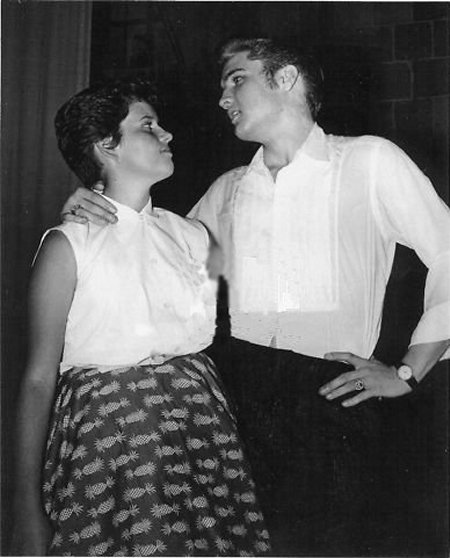
"After the first show, I was lucky enough to go backstage for the second
show. While waiting for the second performance to start, Elvis came over
and started playing the piano, as he did many times before a show. I
visited with him and had a photo taken with him. There were two young
men sitting backstage and Elvis walked over, stuck out his hand and
said, ‘Hi, I’m Elvis Presley.’ The boys nearly fell out of their chairs.
That was the kind of gentleman Elvis was and he was very humble. Ray
Green, a DJ was backstage also, and recorded Elvis’s performance that
night. He was President of the I Met Elvis Fan Club until about 15 years
ago, when he asked me if I would like to take over the Fan Club. Twice a
year, Graceland invites the Fan Club President for a get-together on the
anniversary of his birthdate, Jan. 8, 1935, and the anniversary of his
death, August 16, 1977.” — Joyce Joyner Hightower (Pictured),
Tumbling Shoals
“Oh what a night!!!! I went with my sister, Linda,
and friends Leora, Hazel and Kent Miller. We all lived in Dardanelle and
Kent drove us in his 1955 Chevy.
“I was 16 and had a date that night but couldn’t get in touch with my
date to cancel, so I asked Mother to tell him I had gone to see Elvis.
He was not happy and I don’t think he ever forgave me, but that’s OK it
was worth it.
“I don’t remember what I wore that night but during the fifties we wore
full skirts with lots of heavy starched petticoats, loafers and bobby
socks. We didn’t wear jeans or tennis shoes back then. We couldn’t wear
pants of any kind to school. We always wore dresses or fitted or tight
skirts.
“The concert was great. I loved all of the songs that Elvis sang. But my
favorite of all is ‘Love Me Tender.’
“After the concert, I went back stage and Elvis signed a picture for me.
Being at the Elvis Concert was one of the highlights of my life. I’ve
enjoyed telling my children and grandchildren about going to see Elvis
Presley when I was 16.” — Ann Land Selig, Fort Smith
“My fiancé, my roommate and her fiancé had tickets
for the concert. At the last day, both she and my fiance had to work, so
I went to the concert with her fiance. We took my car, as he did not
have one. “I remember that I wore my pink poodle skirt with the black
poodle and heels. I do not have the stub and do not remember how much
the tickets were, but whatever they were, they were certainly worth
every bit.
“Since we had two extra tickets, we turned them in to the box office
when we got there and the lady almost had a heart attack when we showed
her the tickets. Everyone had been clamoring for tickets.
“The concert was just wonderful. He had everyone wanting to dance in the
aisles and he seemed to enjoy himself. The management of the auditorium
put speakers out on the front so that the ones who did not have a ticket
could hear the concert. The steps going up into the building were full!”
— Verniel East, Searcy
“I was with Judy Fagan in the center third row. We
were in the 9th grade. I had my hair in a duck tail. All I know is we
screamed, hollered, rocked and had a great time.” — Marilyn Thomas
Robison, Little Rock
“Yes, I was there with my mother. I was 14. Neither
of us had any idea of who Elvis was, but my father was given two tickets
and since he had to work that night, we went to see what it was all
about. The tickets were $1.50 each and we sat in the balcony, front row.
It was so electrifying that I was afraid my mother was going to jump
over the railing. She was screaming like any teenager. I screamed too. I
was glad she was having fun with me. I went home that night a true,
devoted fan.
“I fell in love that night. I had never been on a date and I saw this
handsome man, singing beautifully. I fell in love like the rest of the
audience. Mom got over it when she got home, but I didn’t. I bought his
records and magazines, cut out his pictures. One wall in my room was
covered with Elvis pictures.
“As I got older, he lost his glow a bit for me. I used to go to his
movies, I just wanted to see him, look at him. The movie could have been
silent and I wouldn’t have cared.”
— Jeanette Jones Green, Layfayette, La. NOTE: Jeanette Jones Green is married to Ray
Green, the disc jockey who recorded Elvis’ concert that night. They have
been wed for 50 years.
All photos on this site (that we
didn't borrow) unless
otherwise indicated are the property of either Scotty Moore or James V.
Roy and unauthorized use or reproduction is prohibited.