 |
The Fox Theater - Detroit, MI
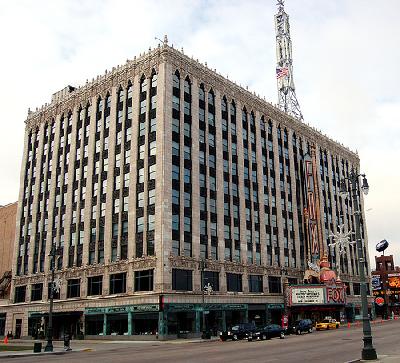
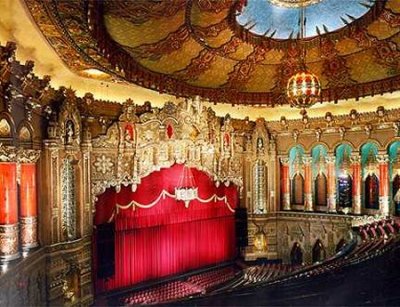
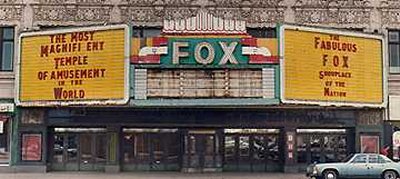
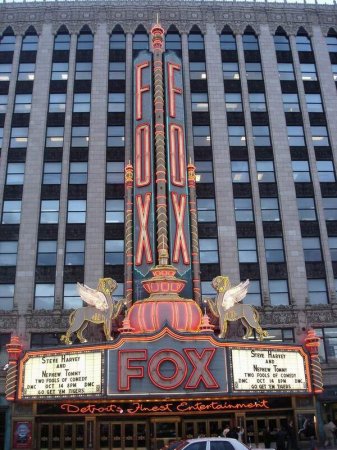
When the opening-night curtain rose at Detroit's Fox Theatre on Sept. 21, 1928, an audience of 5,000 invited guests came to 2211 Woodward Avenue to see what had been billed as a "Temple of Amusement." They did not go home disappointed.1
The Fox Theater was the first in the world to be constructed with built-in equipment for talking movies. Under the Fox Movietone patents, a highly sensitive photo-electric cell converted sound waves into light waves back into sound that was amplified and passed by cable to the stage. It took 18 months to build this theater, costing an estimated $12 million. The original staff numbered over four hundred, including ushers, set designers, matrons and doormen.1
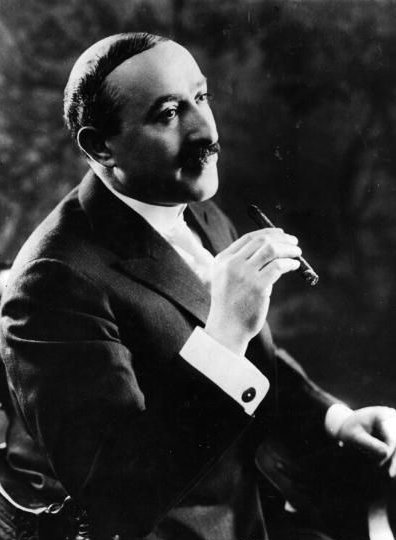
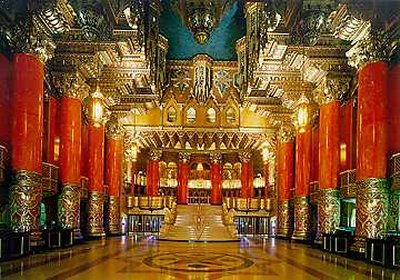
The Theater, an awe-inspiring combination of Far Eastern, Indian and Egyptian styles, was the second largest Theater in the world, but it surpassed all others in grandeur. It was designed by architect Charles Howard Crane, a Detroiter who was also responsible Olympia Stadium in Detroit as well as 250 movie houses across Canada and the United States.1 Crane called his design a "tasteful blend of Hindoo and Burmese styles," though others later dubbed it "Siamese Byzantine" and even "Cambodian Gothic."2 Credit though for the magnificent interior belongs to Eve Leo, wife of pioneer film producer William Fox. Fox was founder of the company which still bears his name today -- Twentieth Century-Fox.1
Fox, son of Hungarian immigrant parents, had a rags-to-riches-to-rags career. Turned down around the turn of the century for a $3 raise from his $17-a-week job as a pants presser on New York's East Side, Fox took his savings and bought a down-at-the-heels Brooklyn nickelodeon. At the height of the post-war boom 25 years later he was the ruler of a cinema kingdom which included Detroit's Fox Theater.1
A few months after the stock market crash of 1929, he lost controlling interest in the Fox Films Corp. and the Fox Theaters Corp. and resigned his leadership positions at both firms. He continued on as chairman of the companies' advisory board but a welter of stockholders lawsuits and government tax judgments drove him to voluntary bankruptcy in Atlantic City, N.J., in 1936.1
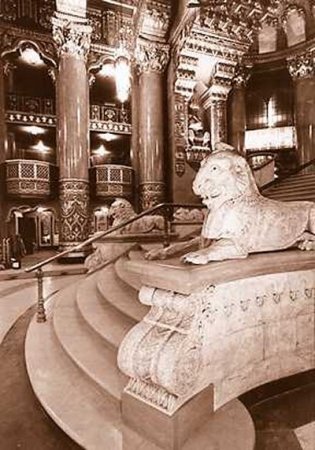
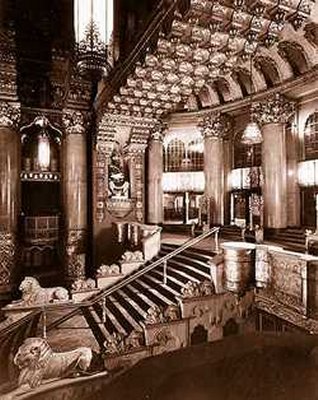
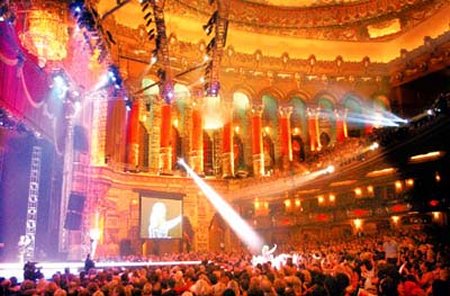
The lobby of this mammoth 10-story structure, which was six stories high and half a block long, was surrounded by blood-red marble columns. Each column held its own jeweled figure representing various Asiatic Gods.1 The decorative scheme used subdued tones of gold to contrast a riot of color. Hangings in the lobby were in golden damask and stage draperies combined regal-red velour and damask which were set off by a festooned drapery with a wide silken fringe.1
The 3,600-square-foot lobby was covered by the largest wool rug ever made by an American manufacturer. Weighing approximately 3,000 pounds, this carpet reached to the foot of the lobby's grand stairway that led to the mezzanine and balcony levels. There was also an escalator and large passenger elevators --- the only theater in Michigan so equipped.1
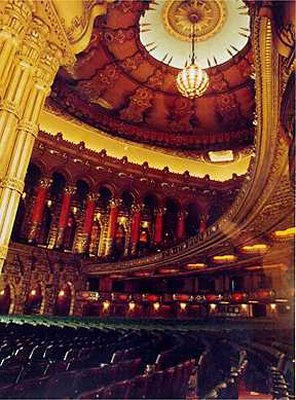
The auditorium was 175 feet wide and 110 feet high. Large colonnades flanked the auditorium and behind these was a promenade where the patrons could stroll and view the entire theater. A tier of seats in the rear of the balcony were designated as smoking loges and equipped with special fans to carry away the smoke.1
The main ceiling of the auditorium was designed as a huge canopy, with sky lights above it, and decorated in the style of the durbars of India. One innovation in movie theater construction was the inclusion of three-foot aisles in front of every row of seats. This allowed for the passage of patrons without making it necessary for those seated to stand.1
The orchestra pit was built on a platform that could be raised and lowered by pneumatic pumps. Similar platforms built into the stage allowed for unusual effects. The theater was equipped with loudspeakers that would provide a uniform tonal quality throughout the entire theater. The inaugural performance at the Fox opened with the playing of "The Star Spangled Banner" by the 60-musician-strong Fox Theater Grand Orchestra as they rose dramatically into view on the elevator platform.1
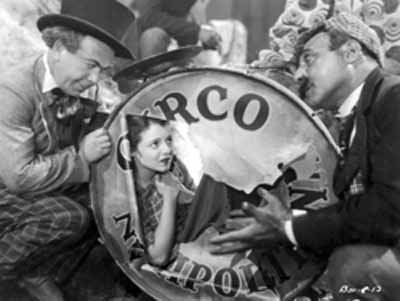
On stage the inaugural production, "The Evolution of Transportation," depicted the progress of Detroit from Indian days to the present utilizing a troupe of 32 dancing girls called Tillerettes and a choir of 50 voices. This performance was followed by the showing of a Fox Movietone news reel---with sound. The feature film was "Street Angel," starring Charles Farrell and Janet Gaynor,1 the least-known of three films for which Gaynor received an Oscar.
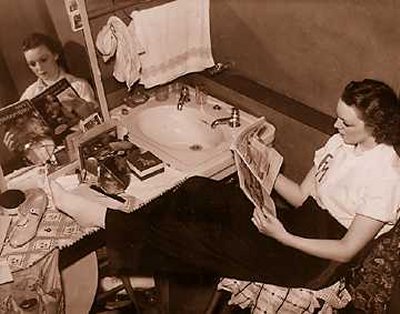
In 1937, Detroit News reporter Rex Grover featured the Fox's Gae Foster Girls -- a chorus group that performed between movies -- in a pictorial special that ran in the weekend Roto magazine. His account of their backstage life implied that they sat around reading confession magazines, passing their time with idle gossip. The chorus girls were so incensed that they wrote a letter to the editor of The Detroit News challenging the reporter to find six girls from Detroit -- no Phi Beta Kappa's -- to compete against six from their group in an intelligence contest.1
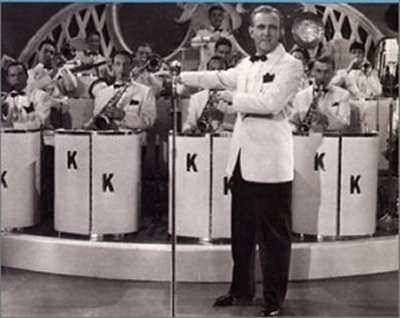
Weekend attendance records were toppled by Kay Kyser and his Kollege of Musical Knowledge in March of 1939. More than 61,000 persons jammed the house over three days, surpassing previous attendance records set by Benny Goodman, Tony Martin and other favorites of the time.1
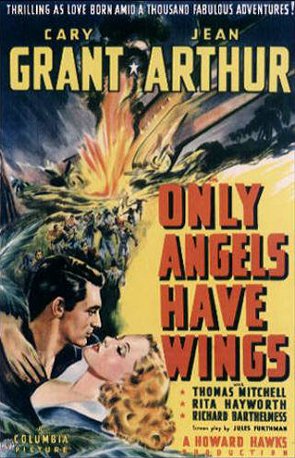
In keeping with the spirit of Memorial Day, The Fox Theater began observing "Americanism Week" in 1939. All Detroiters having obtained their final American citizenship papers since May 1st of that year, were guests of the theater during the showing of "Only Angels Have Wings." The presentation of their citizenship papers plus the required Federal admission tax allowed them entrance.1
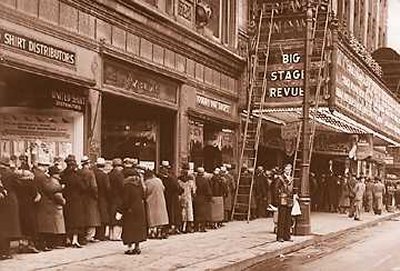
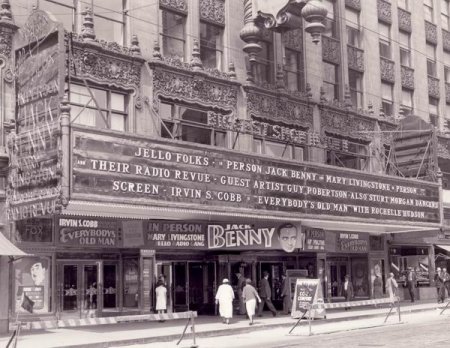
Various owners kept the Fox open and profitable through the 1940s with such acts as Benny Goodman, Sarah Vaughn, Louis Armstrong, Kate Smith and Jack Benny packing the seats. The Fox grossed $75,000 a week during World War II, offering a steady stream of newsreels and movies to audiences hungry for war information and diversion. On Feb. 19, 1943, the first "war-worker dawn show" had more than 9,000 war plant workers from the night shift attending its 2 a.m. show. Workers were encouraged to "come as you are" and enjoy some much needed entertainment.1
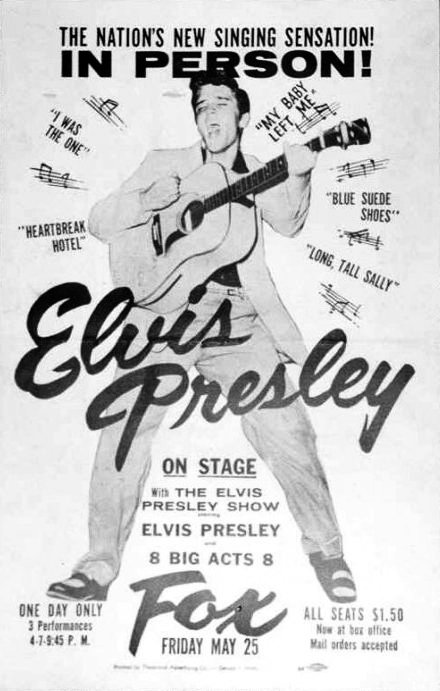
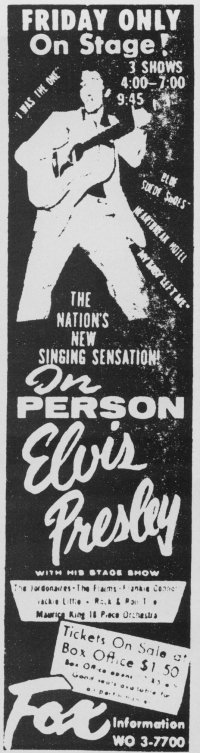
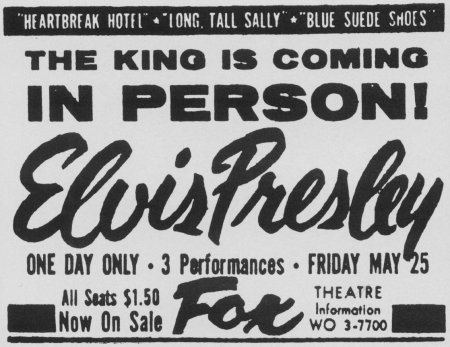
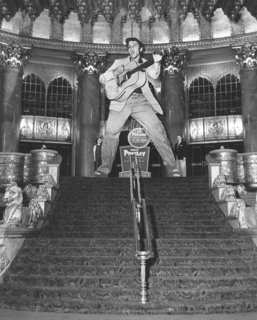
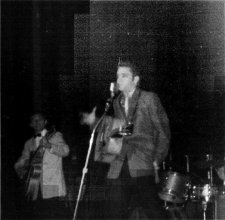
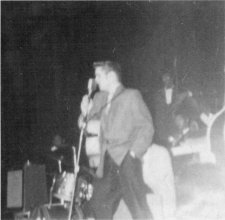
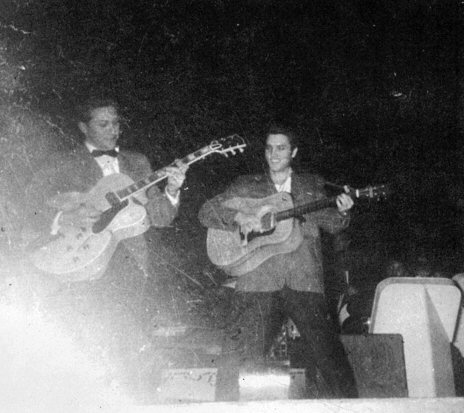
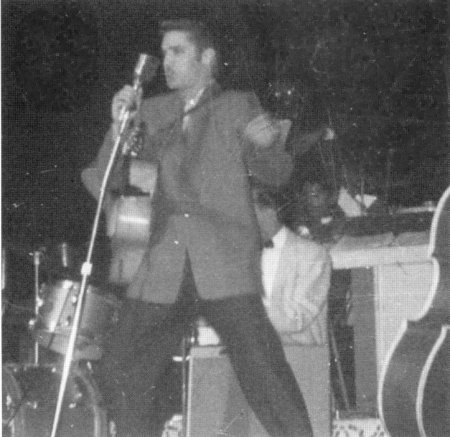
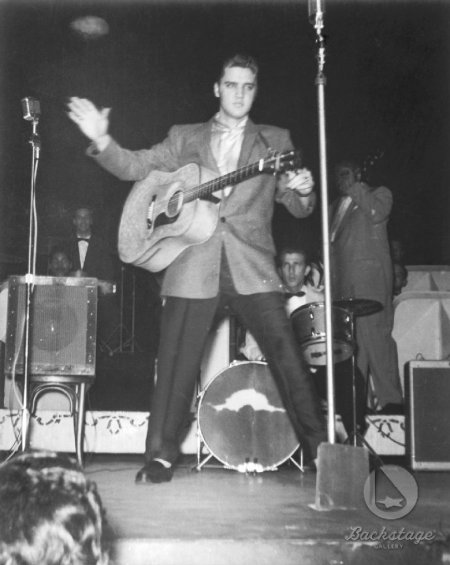
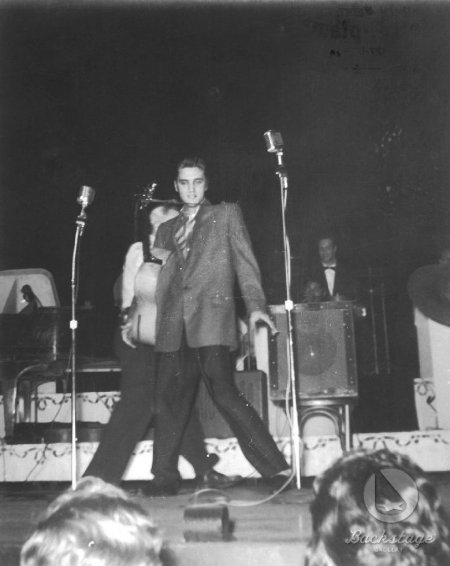
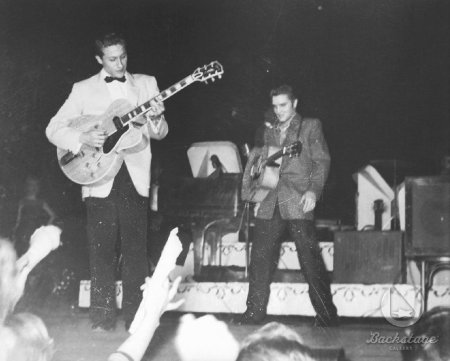
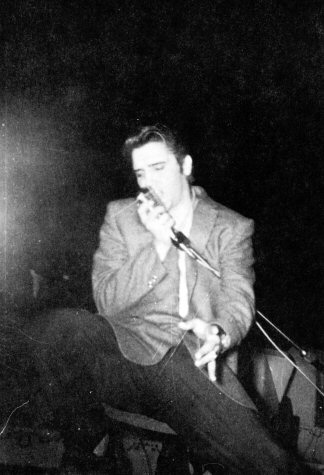
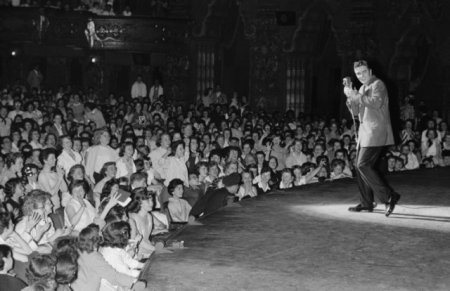
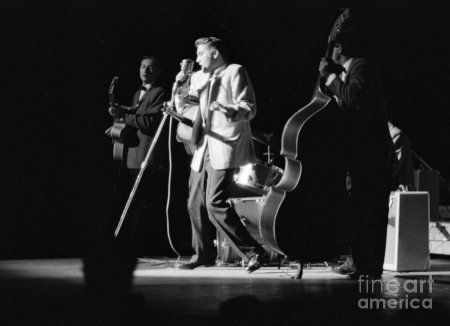
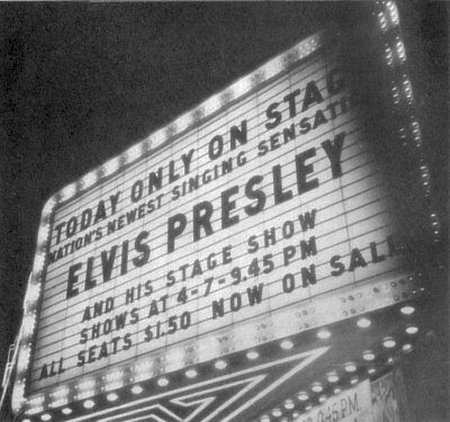
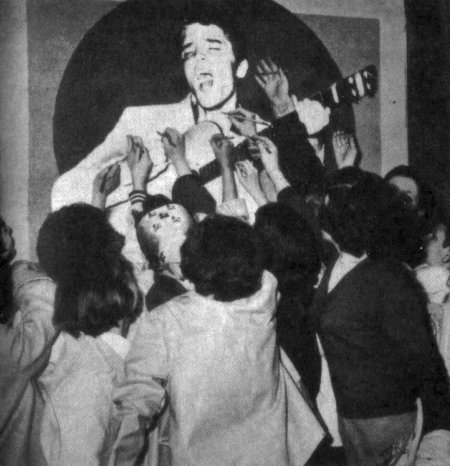
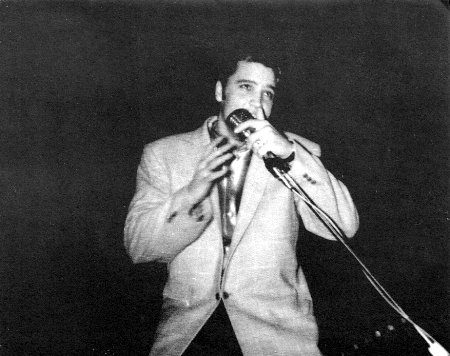
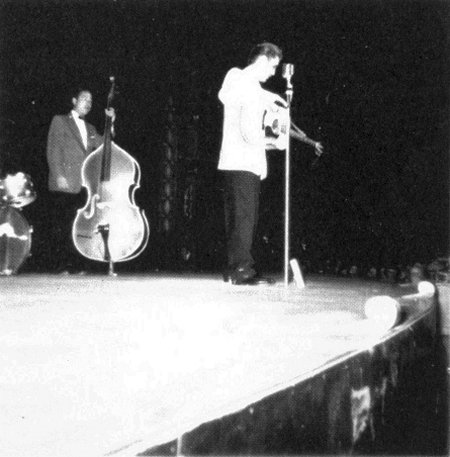
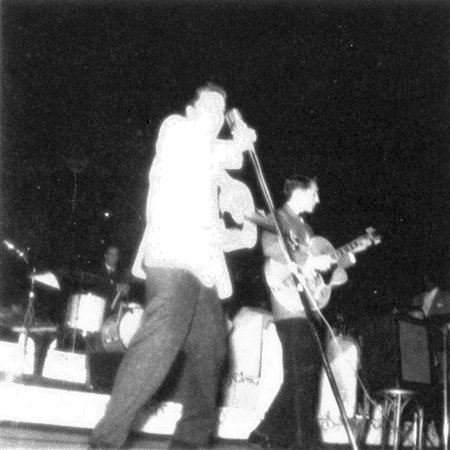
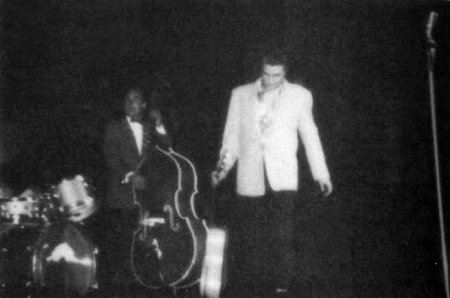
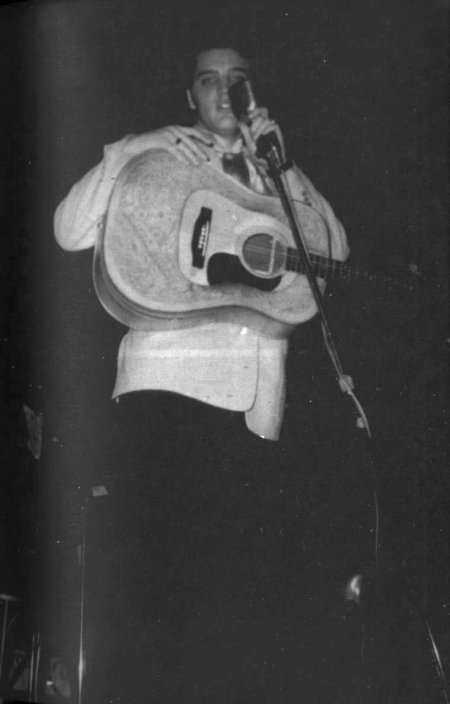
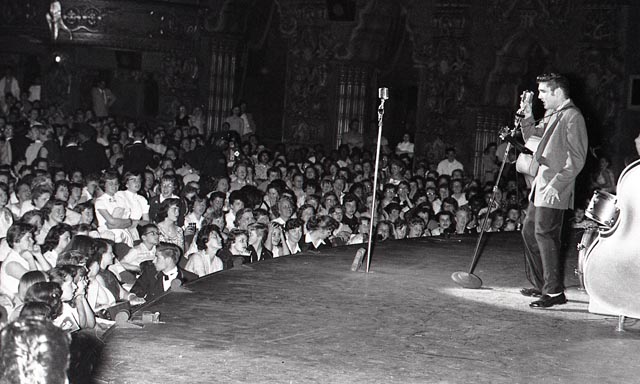
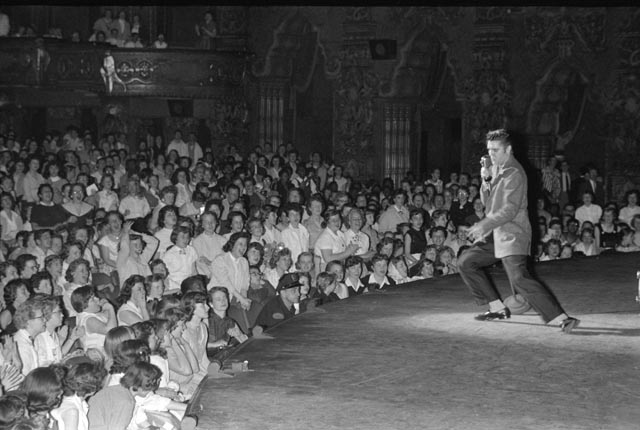
On May 25, 1956, Elvis, Scotty, Bill and DJ were booked to play their first time in Detroit with 3 shows at the Fox. They had already made their first Milton Berle show appearance onboard the aircraft carrier USS Hancock in San Diego, had recently finished a two week engagement in Las Vegas and were scheduled to make their second Berle show appearance in less than two weeks. The newspaper advertised the shows with a full page insert supplement, and on the day of the show fans were greeted with a larger than life size standee of Elvis at the top of the theater lobby's grand staircase.
Charles Manos of the Detroit Free Press gave a somewhat favorable review of the show the following day when he wrote, Elvis Presley, the rock-n-roll dreamboat, danced up a storm in Detroit Friday. Some 15,000 teenager, mostly girls, paid nearly $25,000 in small change to watch him sing, play the guitar and wiggle across the stage at the Fox Theater. His take-home pay for the three performances was estimated at $10,000.3
Tired and yawning between performances, the 21 year-old hillbilly blues singer said he is amazed as anyone over his tremendous success. In less than six months, bobby-soxers have bought more than five million recordings by the former truck driver from Memphis, Tenn.3
A modest, good looking youth who does not drink or smoke, Presley described it all as a 'dream come true.' 'I never was a lady killer in high school,' he said. 'I had my share of dates but that's all.' Wearing long smooth sideburns and a bright red satin shirt, Presley said he wished he had time to have a coke with each one of his fans.3
Ernestine Waynick, 14, of 428 Heidt, was typical of the teen-agers in the audience. 'Wow,' she said, 'I like his actions.' She said she ran errands and turned in pop-bottles to save $4.50. That's the price for the three performances.3
Another review in a Detroit paper was just a bit dismissive. An Atomic explosion of juvenile emotion hit the Fox Theater last night. It was triggered by Elvis Presley, the singer with the profile of a Greek god and the motions of a Gilda Gray who is the current sensation of the rock 'n' roll business.4
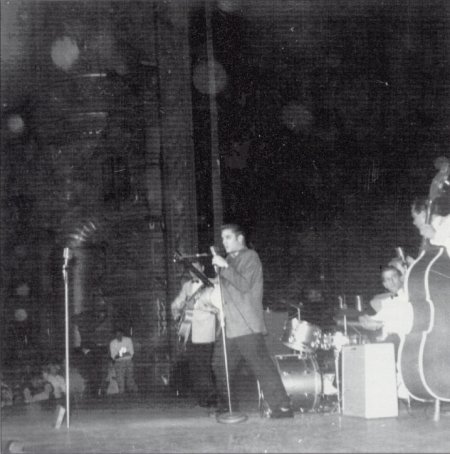
Sporting a green jacket, tight pants and a guitar, Elvis loped onto the stage for three performances. The guitar seldom twanged, because Elvis was too busy flexing his thighs like a soubrette in the palmy days of burlesque. With each manipulation, local adherents of the Presley cult cut loose with screams that put to shame the pandemonium raised by Frankie Sinatra, Tony Martin and Martin and Lewis, prime favorites of the old swoon days at the Fox.4
Elvis was singing to a wicked beat, but only the cool heads knew he was doing 'Heart-break Hotel,' 'Blue Suede Shoes,' 'Long Tall sally,' and 'I got a Woman' and 'My Baby Left Me,' all milestones in his meteoric career as a recording artist.4
There were other acts, including the Jordanaires, who did an excellent job of setting up Presleys' stint with some bouncy quartet singing, but they only served merely to mark time until the Marlon Brando of the mountain music set arrived.4
A stout cordon of city and private police kept in hand the 12,500 teen-agers and others who attended the three shows. It is estimated that Presley got close to $10,000 for his chore of about an hour and a half. Not bad for a 21-year-old who was driving a truck in Memphis, Tenn., only a year and a half ago.4
It is interesting to note the growing disparity in income now in just over a year between Elvis and the rest of the band. While it was reported that he walked away from this appearance with almost $10,000, Scotty and Bill were still only earning their $200 a week salary. By the time of their appearance back in Memphis, on July 4th at Russwood Park, Scotty would be behind in child support and have to refinance his guitar in an attempt to make ends meet. The next time they returned to Detroit was in 1957, at the Olympia Stadium.
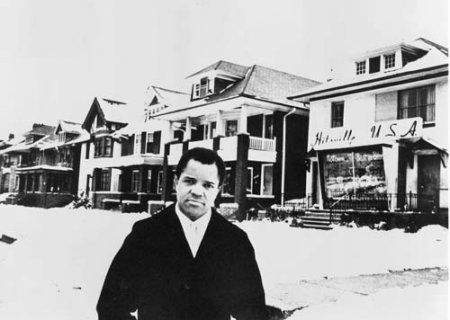
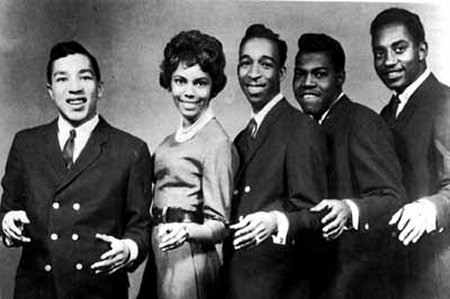
In 1957 a singing group called the Matadors, who were fronted by a young singer called Smokey Robinson, auditioned unsuccessfully for the manager of Detroit native Jackie Wilson. But another young man, who wrote for Jackie, watched the audition, saw something Wilson's manager had obviously missed and persuaded the group to change their name to the Miracles and work with him instead. That man, of course, was Berry Gordy Jr. 5Smokey Robinson saw something in Gordy, too, and urged him to start his own recording company.5 In 1959, Gordy took an $800 loan from his family and with that he turned Motown into the most successful Black-owned label in history. With the money, Gordy bought a house at 2648 West Grand Blvd. in Detroit and named it ''Hitsville USA.'' The home doubled as a recording studio.6
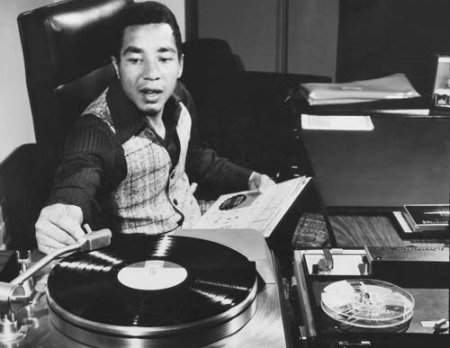
William "Smokey" Robinson was not only a singer, songwriter and producer, but quickly became a vice president at Motown when Berry Gordy Jr. saw his leadership and organizational skills. A Northern High School grad who grew up near Aretha Franklin, Robinson was deeply influenced by tenors like Clyde McPhatter, and Detroit's own Nolan Strong of the Diablos. Smokey and the Miracles, which included his wife, Claudette Robinson, had their first Motown hit with "Shop Around" in 1960.6
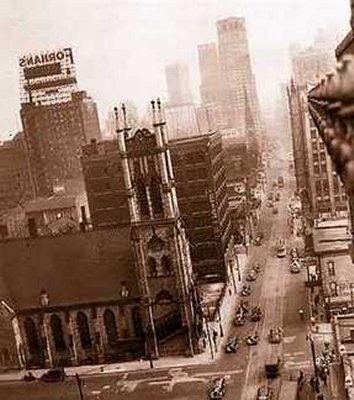
By the 1960s, suburban development and a host of new theaters across Eight Mile, the road that divides the city of Detroit and its northern suburbs, threatened the economic survival of downtown's great old movie houses.2 Berry Gordy's Motown Revue began a Christmas tradition in the early '60s. The Fox was packed for ten days from Christmas to New Year's with four or five shows daily featuring home-grown talent like the Temptations, the Supremes and Smokey Robinson.1
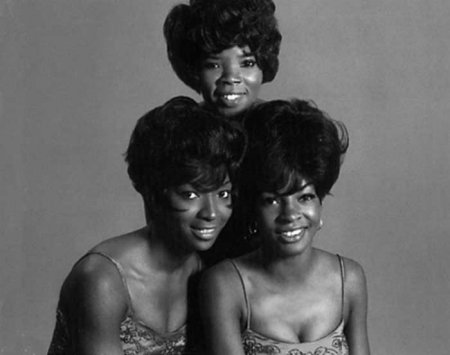
Martha Reeves and the Vandellas played the Fox routinely in the mid-'60s, part of Motown's "Motortown Revue," which temporarily brought life back to the theater with four shows a day. She recalls a soiled masterpiece. "We had no idea those elephants were in there," Reeves said of the spectacular ornamentation, now restored to its lustrous gold, "because it was so dingy. Our little Mary Jane shoes used to get so dirty!"2 By 1966, three out of every four Motown releases made the charts. The stars were polished by Motown's "Motown U pros" who taught them how to dress, stand, wear makeup, and do the motions with style, poise and grace. 5
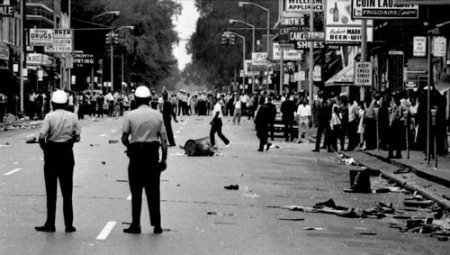
On July 23, 1967, Reeves was just launching into her first live performance of the new hit, "Jimmy Mack," at the Fox when somebody beckoned furiously from the wings. "I thought, 'Oh God -- my dress must be unzipped,'" she said, "because that happened sometimes. "But they said, 'There's a riot outside. And you've got to tell everybody to quietly go home and be careful.'"2 12th and Clairmount streets in Detroit was the epicenter of the 1967 civil disturbance that followed a predawn police raid on a blind pig -- an illegal drinking establishment on Sunday, July 23, 1967. Reports of looting began pouring in just an hour after the police raid. Between looting and fires, more than 500 businesses were destroyed and another 500 damaged -- an estimated $50 million in damages. When the violence ended five days later, 43 people had died. The racial unrest became known as the nation's worst. 6Motown moved from Detroit to California in the mid-1970s, but removed from its roots it was never the same again.5
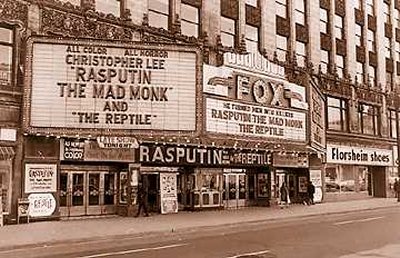
The Fox limped through the 1970s with a host of horror and Kung-fu flicks. "Every night after the show, the auditorium reeked of urine and other disgusting things," recalls John M. Lauter of Farmington Hills. He and a youthful band of theater guerrillas formed a nonprofit, the Friends of the Fox, to keep the immense Wurlitzer organ in decent repair, and to do what they could to stem the theater's rot.2 Hope began to displace despair in 1984, when theater developer Chuck Forbes bought the property for $1 million. While Forbes was unable to put his renovation dreams into action, he kept the theater safe until Mike Ilitch swooped down from the suburbs and made the theater and its 10-story office building his new Little Caesers corporate headquarters.2
"Many, many people thought we had lost our business marbles," daughter Denise said. But the family had wanted to expand its downtown entertainment franchise, she explains, which already included the Detroit Red Wings. And, as she notes, her parents had grown up with the Fox.2
The new owners immediately put in motion a top-to-bottom renovation. The result was a resurrection accomplished with 1 million gallons of water, scaffolding that cost $3,000 a day, and $750,000 in new plaster work.2 People working on the renovation found autographed photos of Elvis Presley and vintage movie posters in the dust-filled file cabinets of the theater's promotion office. 7
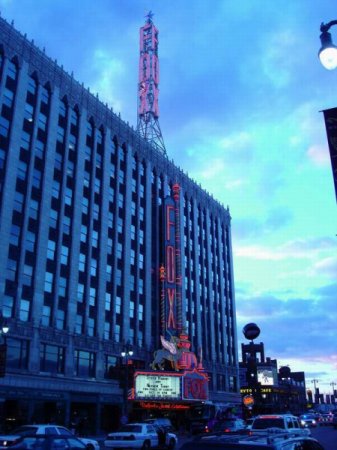
The $12.5 million restoration project, which included a new 10-story marquee, culminated in a grand reopening with Smokey Robinson and the Count Basie Orchestra on November 19, 1988, when the curtain once again rose at the theater known as the "Temple of Amusement."1
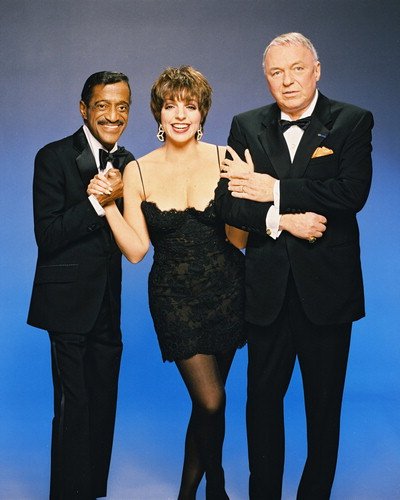
Shortly after its November 1988 reopening, the Fox hosted a blockbuster event featuring Frank Sinatra, Liza Minelli and Sammy Davis Jr.2 The three had been touring since the previous year.
The Fox's impact goes way beyond just boosting downtown's entertainment options. When the Ilitches bought the theater and moved their Little Caesars corporate headquarters into offices above it, they pioneered a virtually abandoned downtown. Detroit is not the only city where theaters have contributed substantially to a rebirth -- experts often cite Cleveland and Playhouse Square, or the emerging theater district in Chicago's Loop. Still, said Doug Kelbaugh, dean of the Taubman College of Architecture & Urban Planning at the University of Michigan, "Detroit may be the most vivid example of theaters leading the way in redeveloping a downtown."2
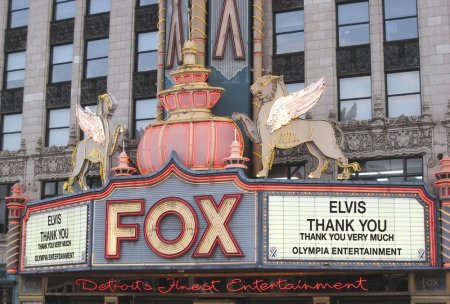
Today, Olympia Entertainment, owned by Mike and Marian Ilitch, is one of the industry's most diverse sports and entertainment companies. Olympia Entertainment owns and operates Detroit's fabulous Fox Theatre and also books and operates Joe Louis Arena, Comerica Park and Cobo Arena. On August 16, 2007, in honor of the 30th anniversary of Elvis Presley's death, Olympia Entertainment looked back at Elvis' performances at Detroit's fabulous Fox Theatre and the Olympia Stadium. Elvis graced Olympia Entertainment stages seven times, performing to a total audience of 121,339 people.8
May 25, 1956: Fox Theatre, three shows, estimated total
attendance 12,000-15,000 page added June 17, 2008 Special thanks to The AEK Lounge's MotorCitySpartan and to Doug Ferich for the links to the Detroit News articles on the Fox, also to the Detroit News for its photos and its staff writers who essentially wrote this page with their coverage of Detroit's history.
1
excerpt from "Detroit's historic Fox Theatre"
by Laurie J. Marzejka, The Detroit News, Jan 25, 1998
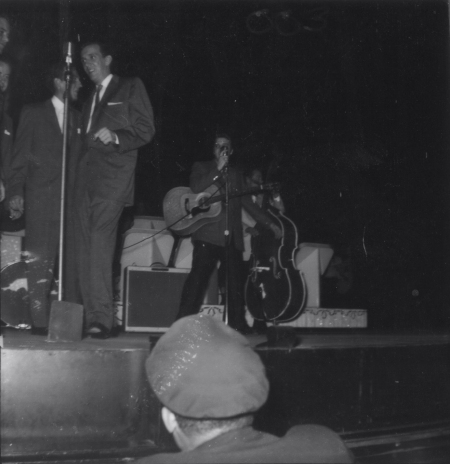
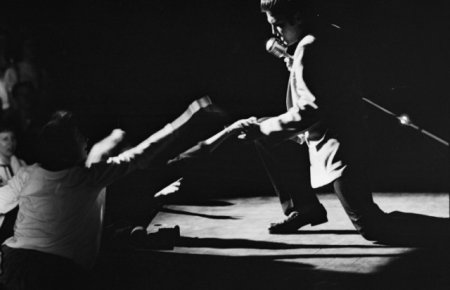
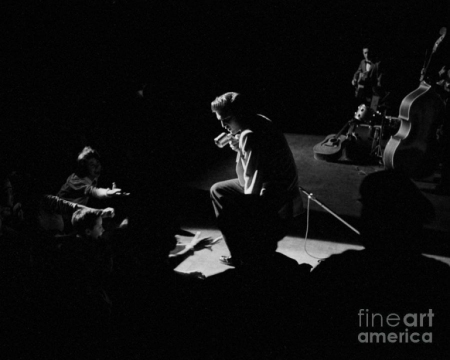
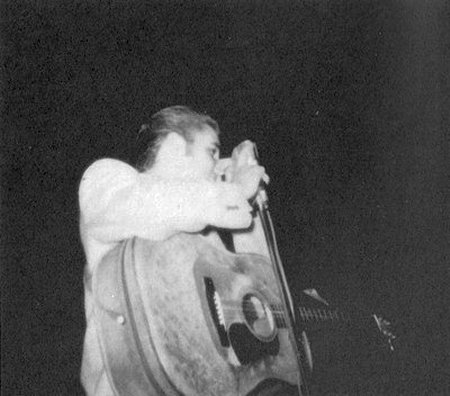
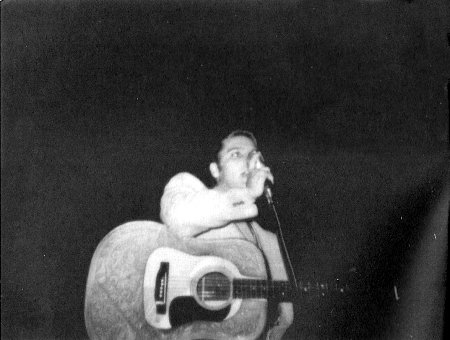
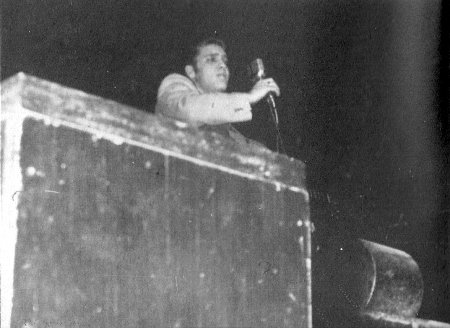
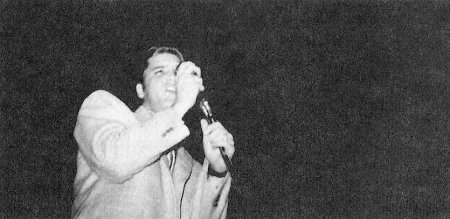
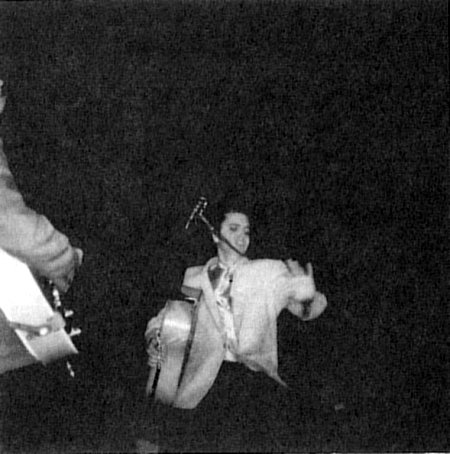
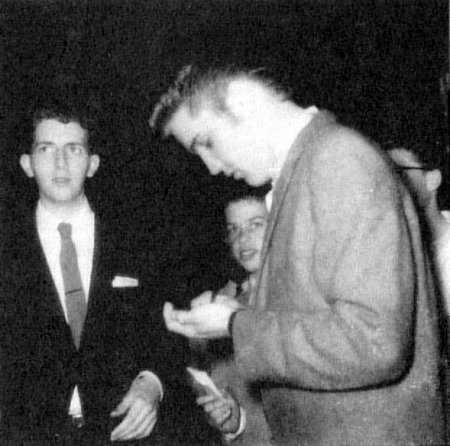
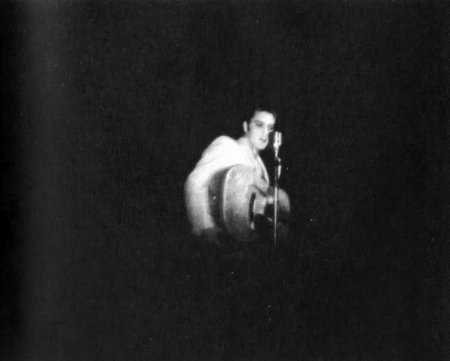
These photos from performances on May 25, 1956 at the Fox Theater initially appeared in issues of a publication called Strictly Elvis and appear here courtesy of Francesc Lopez and FECC/hilton22000.
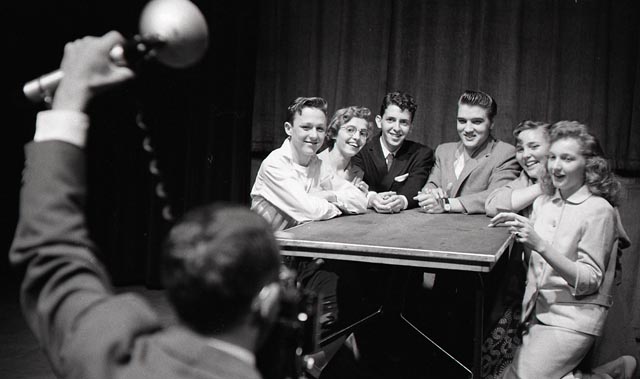
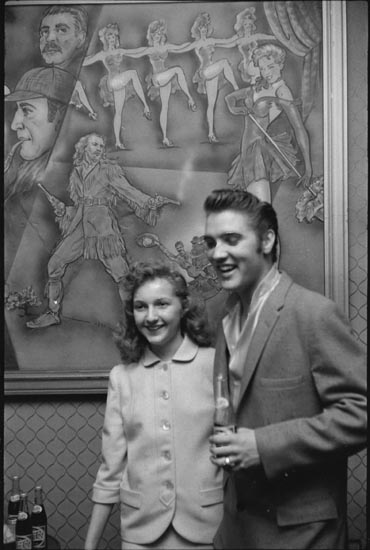
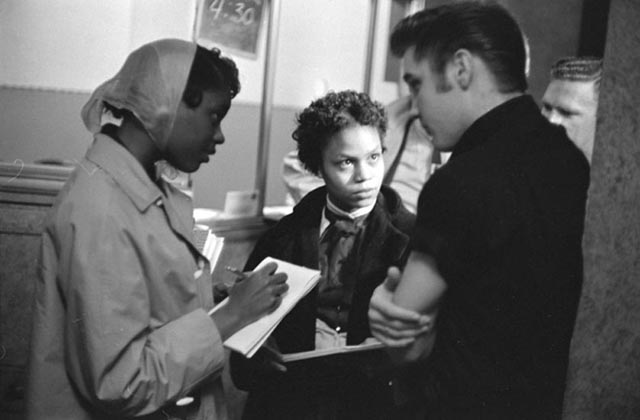
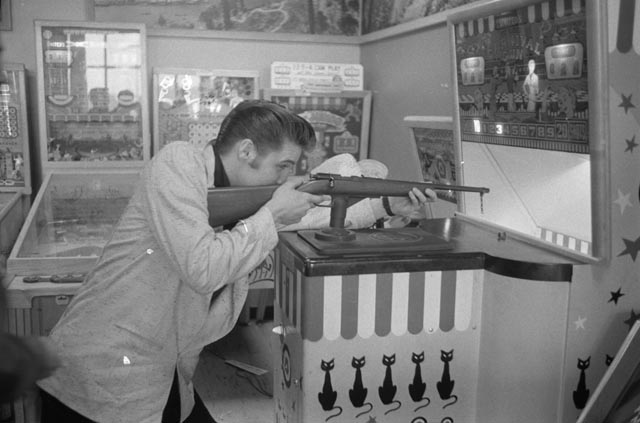
Photos added July 26, 2009 Unseen Elvis: Presley's first visit to Detroit in never-published photos Cache of never-published photos from 1956 shows Presley performing, relaxing in Detroit by Susan Whitall / Detroit News Music Writer It's May 1956. Americans were fretting about President Eisenhower's health, slugger Mickey Mantle was the toast of the baseball world, and 21-year-old Elvis Presley was about to make his first appearance at the Fox Theatre in Detroit. It had been a whirlwind five months for the soft-spoken truck driver from Tupelo, Miss., who recorded his first RCA Records session in January, yielding "Heartbreak Hotel," which shot to No. 1. Elvis was winding up a tour of the Midwest when he came to Detroit on Friday, May 25.
Fifty-five years later, never-published photographs of the day Elvis first came to Detroit have been brought to light by author Michael Rose for a forthcoming book, "Spring of '56." The photographs show Elvis in and around the Fox Theatre, greeting Detroit Times contest winners backstage, relaxing in a downtown arcade and enjoying himself at an adult party. Detroit teenagers may have been ecstatic at Elvis' arrival, but newspaper writers barely hid their disdain. Vera Brown wrote in typically snappy, Detroit Times tabloid style of Elvis: "He rarely gets a haircut, does a kind of hillbilly derivative. When he winds himself around a mike and gives out, the kids go crazy. Nothing like it since the early Frank Sinatra days. … Only way to keep calm about all this is to try to remember how silly you were in your high school days."
Brown met Elvis at the airport, where she demanded to know why he needed four Cadillacs. "I just like automobiles," he said. His latest one was pink with white leather upholstery. Brown also described his turnout: a black shirt open at the throat, and black pegged pants. Why, the columnist demanded of the singer, was he so popular? "If I knew I would tell you," Elvis replied politely. "I honestly don't know how it took place, but if I can go on from here into the movies, that would be swell." He told reporters he doesn't drink and has no girlfriend yet. "I still love my mother who lives in Memphis."
Incredibly, the day before Elvis' three Friday shows (4, 7 and 9:45 p.m.), Bob Bothwell, managing director of the Fox Theatre, said good seats were still available. As if Elvis wasn't enough entertainment for the $1.50 ticket, there were numerous other acts on the bill: The Jordanaires (his backup singers), Frankie Connors, Jackie Little and Maurice King and the Wolverines (the house band at Detroit's Flame Showbar). At age 14, Carol Bainbridge was one of the "teeners" who really didn't care what snarky, middle-aged newspaper writers thought of Elvis. Her father, Larry McCann, had interviewed Elvis on his WXYZ-TV talk show, and he scored her two tickets to the 4 p.m. show. Bainbridge and a girlfriend took a bus downtown from Three Mile Drive and Mack, and sat in the front row. "I touched his shoes and screamed my heart out while he sang in front of me," Bainbridge says.
Elvis had been introduced at that early show by a young Detroiter, Lee Alan Reicheld, who held down the all-night air shift at WJLB. Reicheld, better known by his later disc jockey name, Lee Alan, was told by WJLB's top jock, "Frantic" Ernie Durham, that he had a gig for him. "He said, 'You've got to go to the Fox Theatre and introduce Elvis,'" Alan recalls. The young jock went to the Fox as ordered, and was preparing to open the stage curtains when he heard a soft voice behind him say, "Hey, what's your name?" Alan turned, and it was Elvis, ever the gentleman. He really wanted to know. "Lee Reicheld," Alan told him. "I didn't think he could pronounce it anyway." But he did, and always remembered Alan's real name after that.
By the time Alan opened the curtains to yell, "Ladies and gentleman, Elvis Presley," the screaming was already so loud that nobody heard a thing. "I screamed so much I never heard a word he sang," Bainbridge says. "I'll never forget how he dressed, the way he held the microphone, moved around on the stage. He stood legs apart to swivel, then crouched down to touch outstretched hands. He was different, original and, damn, he was cool. The girls today would say 'hot,' and he was." Reviews of Elvis' show are inadvertently hilarious. The Detroit Times reviewer complained that Elvis did "unknown" songs like "I've Got a Woman" and "Long Lost Sally" (meaning, "Long Tall Sally.")The Detroit News reviewer recognized "Long Tall Sally," but deployed several zingers, describing Elvis as an ex-trucker with a shimmy, and sniffing: "The guitar seldom got twanged, because Elvis was too busy flexing his knees and swinging his thighs like a soubrette in the palmy days of burlesque."
Meanwhile, backstage at the Fox, another Detroit radio personality was making his way to Elvis' dressing room to meet the legend. Robin Seymour had been embroiled in controversy since he'd dismissed Elvis on his WKMH radio show as a fly-by-night phenomenon that wouldn't last. "There were 100 kids on bikes in front of my house with signs," Seymour recalls, laughing. "'Get rid of Robin Seymour, he's a jerk!'"It was a gimmick, Seymour insists; he didn't really dislike Elvis. But Seymour didn't introduce the singer at the later shows — that honor was reserved for Mickey Schorr. Seymour did want to meet him, though, and Fox manager Bothwell got him backstage. There Seymour was to discover that, despite the wholesome reports in the press about not drinking and such, Elvis was having big fun. When the dressing room door opened, the disc jockey was startled to see several naked girls.
"He was sitting on the couch wearing a silk robe; there were about five girls trotting around," Seymour says. Showgirls from the nearby Stone Burlesk? He hasn't a clue. "I didn't stay that long," Seymour says with a laugh. From The Detroit News: Unseen-Elvis--Presley’s-first-visit-to-Detroit-in-never-published-photos added February 7, 2011
*The photos said to be "uncovered" by Michael Rose I believe to have been taken by Phil Harrington while on assignment for Look Magazine. Phil Harrington's photos appear on this site with the permission of Evan Harrington with respect to his father and family and for which we greatly appreciate their use. Evan Harrington has informed us that Michael Rose has no connection to his family, his father or any rights to the images so we've amended the credits accordingly. Oct. 16, 2014 As of December 2014 we have been informed that all of Phil Harrington's photos are now and only licensed through Corbis. Evan Harrington expects to have a system up and running to sell individual prints direct soon.
|
||||
|
All photos on this site (that we didn't borrow) unless otherwise indicated are the property of either Scotty Moore or James V. Roy and unauthorized use or reproduction is prohibited. |